29/09/26September 29, 2026·Personal·6 min read
Twenty Bolívares
In 2017, twenty bolívares bought me a slice of pizza, a drink and a small dessert in Caracas. By December, they bought nothing. What I learned the semester my country ran out of time.
In September 2017, twenty bolívares bought me a slice of margherita pizza, a drink and a small dessert at my university food court in Caracas.
By November, the same amount bought only the pizza and the drink.
By the end of that month, only the pizza.
By December, it bought nothing.
I was 17 years old. That was the first time I understood what it means to watch the value of money disappear in real time.
I. Twenty bolívares
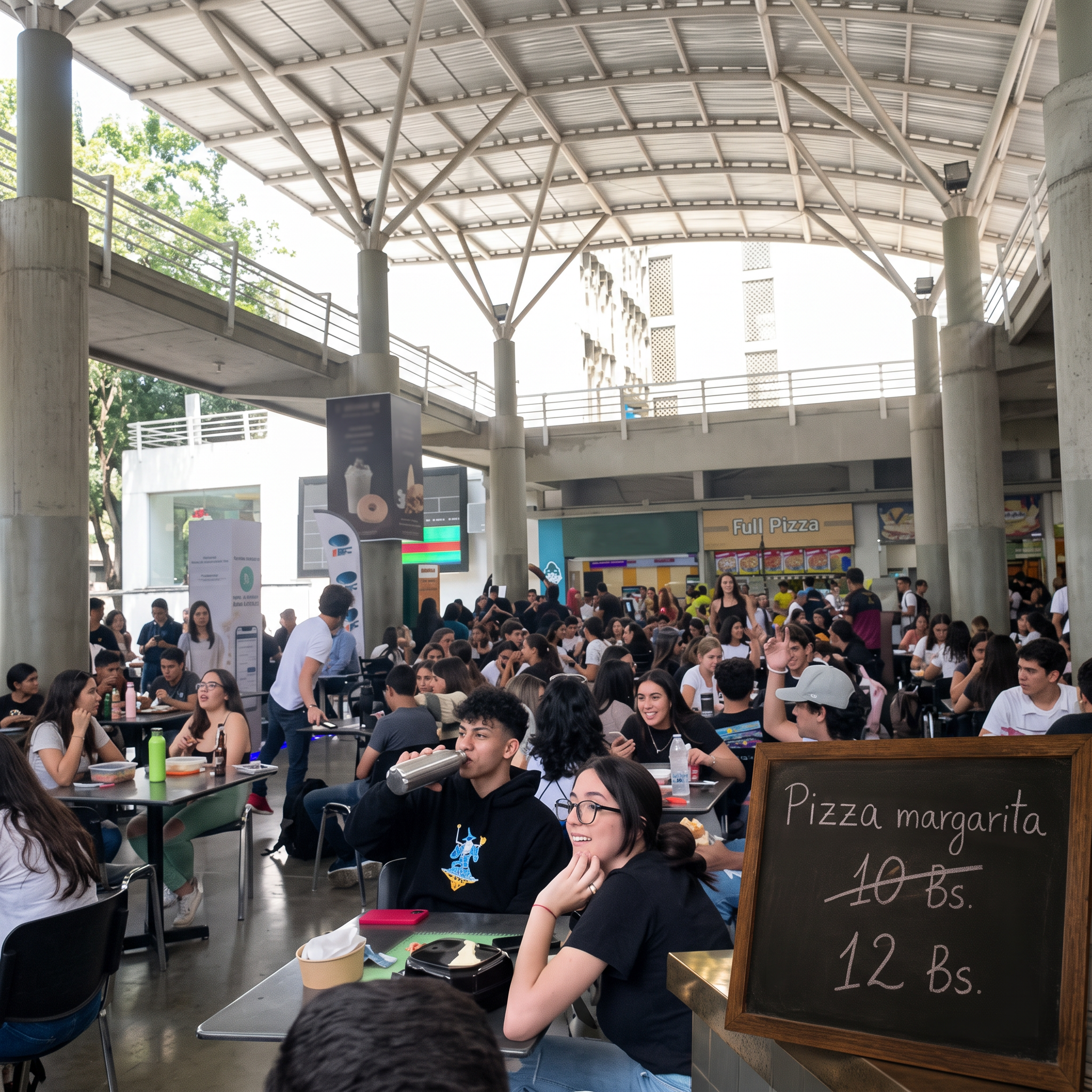
During my first semester at UCAB (Universidad Católica Andrés Bello), lunch at the campus food court was the fixed point of my day. I always ordered the same thing. In October, I noticed it for the first time: new prices written by hand on the boards. Margherita pizza, 10 Bs., crossed out. Below it, 12 Bs.
I was stunned by how fast the prices changed from week to week. And I noticed more and more people around me bringing food from home, even the ones whose families were among the most privileged.
That first semester, I had followed my four closest friends from high school into the same university. I was excited about everything that was about to start. I had taken the admissions exams for my three favorite universities in Caracas and been admitted to all of them; I chose UCAB for its strong reputation in economics. It lasted one semester.
II. A country running out of time
I chose economics because I wanted to understand how a country could fall apart this fast. And Venezuela was falling apart on every front at once.
The economy had contracted more than 35% in four years.1 Annual inflation crossed 800%.2 Oil production, the only real source of foreign currency, fell nearly 13% in a single year,3 which meant fewer dollars to import food and medicine. Empty pharmacies.4 Lines for basic goods. Soaring malnutrition.5
Politically, the "democratic" facade was collapsing in real time. In March 2017, the Supreme Court tried to dissolve the opposition-led National Assembly,6 and the country answered with months of mass protest. From April to July, hundreds of thousands marched against Maduro,7 and more than 120 people died in clashes with security forces and pro-government armed groups, including college students.7 In July, the government bypassed Congress entirely and created a new Constituent Assembly, extinguishing any remaining pretense of democratic governance. More than 8 million Venezuelans would eventually leave,8 almost a third of total population that year.
The numbers finally caught up with my lunch. By the end of December, monthly inflation had exceeded 50% for 30 consecutive days, and Venezuela became the 57th country ever added to the Hanke-Krus World Hyperinflation Table.
Being young in Venezuela in 2017 meant holding two contradictory feelings at the same time: the hope that things would change, and the growing suspicion that they would not, at least not soon enough. I was more optimistic than pessimistic. I still choose to be, consciously, every day.
III. I did not want to leave
I will be transparent: I did not want to leave. My intuition told me repeatedly that the right move was to stay, despite everything happening around me in real time. Whether that was patriotism, fear of the unknown, or love for the people and places I had always known, I cannot say with complete certainty. Probably all three.
I am very grateful that my family never lacked the basics in that period. I managed to bring food home, like many other students. We were not rich at all, but our position was certainly privileged. Still, I could not stop thinking about everyone else. If twenty bolívares disappeared that quickly for me, what did that mean for a parent whose salary had to feed an entire family? For a white-collar worker, a public employee, someone in the informal economy, whose daily purchasing power depended on prices staying still? To watch your income dissipate like sand between your hands, as the head of a family, is a level of despair I could only imagine.
My parents saw that Venezuela was no longer a place where they could run their business, a wholesale distribution company for retail products. One day in December, they sat me down and told me we were moving to Peru, where they had been born and raised, to start over again. The hope was that things would change for the better.
The choice was rational, but emotionally overwhelming. Things had changed so fast, so drastically, that my own willingness was not enough to keep me in a place that, at least for a while, offered no future for someone my age.
On my last day at campus, I went to collect my academic transcript from my first and only semester there. Walking back to the metro station, I ran into a professor I had grown close to. She noticed something in my face and asked: "What's wrong? You look melancholic." I told her: "A few days ago my parents told me we are moving to Peru permanently." She smiled, visibly happy, and said: "That's wonderful, Juan! You should be very happy to have this opportunity. Many people don't have a choice."
I still remember that day very well. What she said was a loss, and also a privilege.
I will always remember those days at the food court with my old and new friends, joking and laughing. The events and associations I took part in. No matter how brief it all was. When I moved to France in August 2018, my mind sometimes drifted back to those times. At some point I needed to move on, and after several months, I did.
IV. The in-between
In the end, things changed for the better for me. Sadly, I know they did not for everyone.
The hardest part was the in-between: the period after the old life had disappeared and before the new one had begun.
I could not control the country I was leaving. I could only choose who I would become after leaving it.
Sources
- Ricardo Hausmann, Project Syndicate · GDP in 2017 was 35% below 2013 levels, 40% per capita, sharper than the US 1929-1933 contraction
- Reuters · Preliminary central bank figures: consumer prices rose 800% in 2016 while GDP contracted 18.6%
- Reuters, citing OPEC · Crude production fell nearly 13% in 2017 to 2.072M bpd, a 28-year annual low
- Convite, El Estímulo · Over 80% of medications disappeared from pharmacy shelves
- ENCOVI 2017 (UCAB/UCV/USB) · Survey of 6,168 households: 80% food insecurity, 8.1 million people eating two or fewer meals a day
- CNN · Venezuela's Supreme Court dissolves the opposition-led National Assembly, March 2017
- OHCHR, UN Digital Library · Documents the April-July 2017 protests and deaths in clashes with security forces
- UNHCR · 8.4 million Venezuelans were refugees, asylum-seekers or in need of international protection by end of 2024
One more thing. I am building a newsletter engine to notify recurrent readers about my content. Click here to be included in the list.